Can Hanwha Eagles’ Power Hitter Ro Sihwan Achieve MLB Dreams Despite Swing Mechanics Challenges?
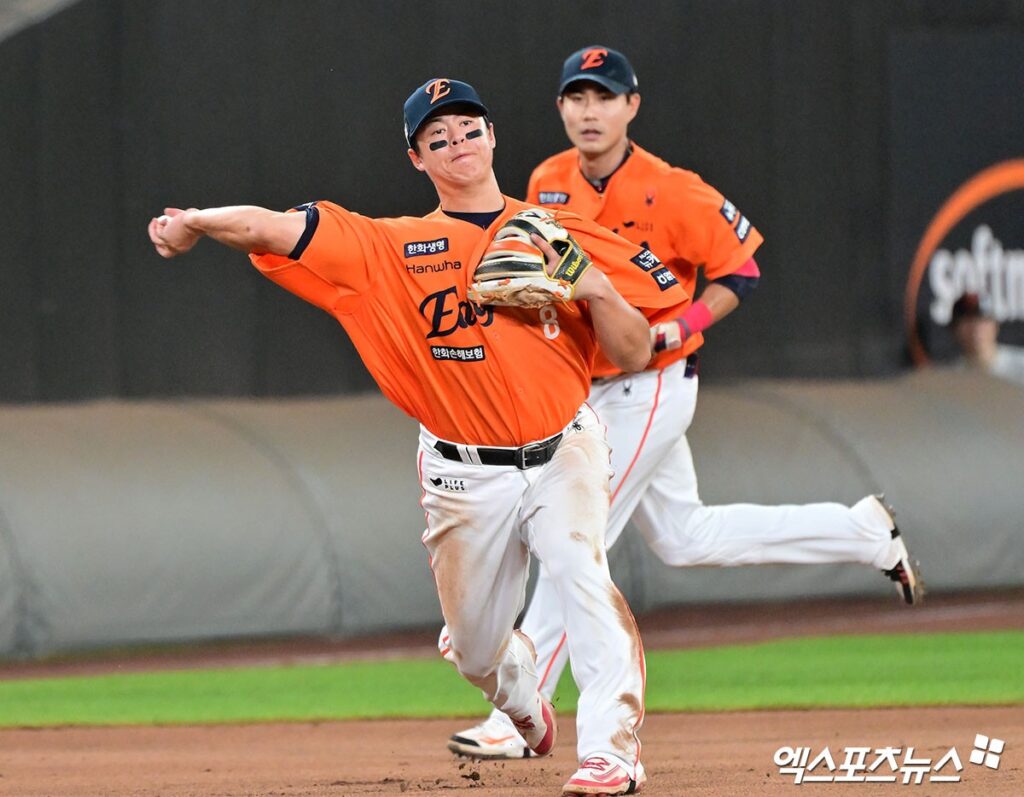
Analyzing why Hanwha Eagles’ Ro Sihwan’s impressive 32-home run 2025 season faces significant barriers to MLB career success. Deep dive into hitting mechanics, scouting evaluations, and player development prospects.
Ro Sihwan achieved his career-high 32 home runs in the 2025 KBO League season, establishing himself as one of Korea’s most dominant power hitters. Yet despite these impressive statistics, Major League Baseball scouts have offered surprisingly pessimistic evaluations regarding his prospects for international success. The 24-year-old right-handed slugger for Hanwha Eagles compiled remarkable numbers including a 144-game iron man streak, 101 runs batted in, and an OPS of 0.851, while serving as a crucial contributor to his team’s Korean Series championship victory. However, MLB scouts have consistently maintained that Sihwan’s current skill level falls short of the demanding standards required for big league competition. This evaluation extends beyond simple statistical comparison and focuses on fundamental mechanical deficiencies in his batting approach. The Sihwan case exemplifies how elite KBO League performance does not automatically translate to international readiness, and highlights the substantial gap between domestic dominance and the requirements of professional baseball’s highest level.
Understanding Sihwan’s batting capabilities requires careful examination of his 2025 regular season performance in detail. Playing in all 144 games of the season, Sihwan demonstrated exceptional durability and consistency, posting a .260 batting average with 32 home runs and 101 RBIs. A particularly noteworthy achievement was reaching his 100th career home run, marking the first time a player born in the 2000s has accomplished this milestone in the KBO League. These numbers underscore the genuineness of his power production capabilities. Additional statistics including 97 runs scored and 14 stolen bases indicate he represents more than a one-dimensional slugger—his overall offensive contribution spans multiple dimensions. Despite a slow start with a .232 average and .759 OPS in the first half of the season, Sihwan’s second-half resurrection featuring a .378 batting average demonstrated adaptive capacity and commitment to improvement, signals that offer some encouragement for future development.
However, the critical issues identified by MLB scouts lie beneath the surface of these impressive statistics, rooted in structural batting mechanics weaknesses. Sihwan recorded 125 strikeouts during the 2025 season, placing him among the league leaders in this category. His 22 double plays grounded into similarly reinforced the perception of an unreliable hitter in clutch situations. Analysis provided by former major leaguer Kang Jeong-ho, examining Sihwan’s batting mechanics, identified three primary deficiencies. First, the timing coordination between his leg kick and trigger mechanism creates difficulty in bat control and consistency. Second, irregular right knee movement compromises swing uniformity and reliability. Third, the collapse of his left shoulder wall causes extended swing paths that make reacting to high-velocity fastballs extremely challenging. While these mechanical issues can be partially overcome in the KBO League through raw power, they become potentially disastrous when facing MLB pitchers routinely throwing in excess of 150 km/h with sophisticated breaking ball arsenals.
Any evaluation of Sihwan’s MLB prospects must consider the instructive case of Park Byung-ho. Park achieved home run titles in the KBO League and shared Sihwan’s image as a dominant right-handed power hitter. However, upon arriving in MLB, Park struggled significantly against premium velocity, posting prohibitively high strikeout rates that ultimately forced his return to Korea. Baseball professionals consistently point out that Sihwan potentially faces an identical trajectory. While both players possess elite power potential, the comparative weakness in plate discipline and breaking ball recognition becomes the determining factor in MLB survival. Notably, Sihwan’s strikeout and double-play issues have been repeatedly mentioned problems throughout his KBO career, and these deficiencies would presumably worsen substantially in the more demanding MLB environment.
Evaluating Sihwan’s current batting abilities against major league standards suggests extremely limited prospect for near-term advancement. MLB scouts establish demanding criteria requiring both an OPS exceeding 0.900 and demonstrable dominance in at-bat discipline. His current 0.851 OPS, while elite by KBO standards, falls considerably short of reasonable expectations for a major league third baseman. Furthermore, data regarding Sihwan’s batted ball distribution indicates that despite an impressive hard-hit percentage, his actual slugging percentage fails to match expectations. This paradox indicates that while Sihwan’s raw power remains exceptional, his consistency in converting that power into successful batting outcomes remains relatively modest—a concerning disparity when facing the refined pitching he would encounter in MLB. The gap between his demonstrated power and his overall batting success rate portends significant vulnerability against increasingly sophisticated pitching strategies.
The Hanwha Eagles organization is actively pursuing a non-free agent multi-year contract with Sihwan, reportedly offering compensation ranging between 1.5 billion and 2 billion Korean won annually. This development reflects Sihwan’s rapidly rising market valuation while simultaneously presenting complex decision-making considerations. Since Sihwan qualifies for free agency following the 2026 season, accepting a non-FA multi-year contract could be viewed as accepting significant discount from his true market value. Conversely, his chronological age of 24 years presents a tremendous advantage. Most KBO players reach free agency between ages 29 and 31, making Sihwan’s opportunity to enter the international market during his peak earning potential years extraordinarily rare. Should Sihwan eventually elect international competition starting in 2027, he would negotiate from a position of considerable timing and leverage advantages.
Realistic assessment of Sihwan’s MLB pathway increasingly points toward Japanese NPB as the most practical route. Direct MLB advancement appears unlikely given current mechanical limitations and strikeout propensity, but the NPB provides an intermediate environment—less demanding than MLB while remaining significantly more challenging than KBO play. Successfully competing in NPB for one to two seasons while simultaneously improving plate discipline and reducing strikeout rates could dramatically enhance MLB viability. This represents a validated pathway that multiple Korean players have previously navigated successfully. Considering the documented difficulty of KBO-to-MLB transitions for hitters versus pitchers, NPB-mediated advancement represents a strategically sound alternative. Historically, KBO hitters achieving direct MLB success remain remarkably rare, with successful transitions concentrated predominantly among Korean pitchers.
Overlooking Sihwan’s positive attributes would be fundamentally incomplete analysis. First, at 24 years of age, he remains young enough to substantially modify batting mechanics. Under expert coaching focused on leg kick timing, trigger precision, and shoulder stability, his current deficiencies could receive meaningful correction. Second, his defensive capabilities remain stable. As a third baseman possessing good arm strength and reasonable defensive range, Sihwan would likely earn defensive credibility even in an MLB context. Third, international tournament experience has provided exposure to high-pressure environments, and his 2025 postseason performance demonstrated clutch-moment reliability. These factors collectively suggest meaningful upside potential for future development.
Current evaluation of Sihwan’s MLB advancement possibilities most reasonably concludes: short-term (2027-2028) success appears highly unlikely; however, medium and long-term advancement remains possible contingent upon meaningful mechanical improvements and competitive experience. This assessment represents not negativity toward Sihwan personally but rather objective diagnosis regarding MLB’s demanding requirements. Elite KBO League performance does not automatically satisfy major league standards, and the technical refinement gap—especially in batter plate discipline—remains substantially more significant than many recognize. The critical determinant of Sihwan’s ultimate international prospects will be the concrete improvements he achieves by the conclusion of the 2026 season.
#RoSihwan #MLBprospect #BattingMechanics #KBOLeague #PowerHitter #HanwhaEagles #BaseballScouting #BaseballAnalysis #ProfessionalBaseball #InternationalBaseball #PostingSystem #CareerDevelopment #SportsAnalysis #BaseballGlobalization #PlayerEvaluation