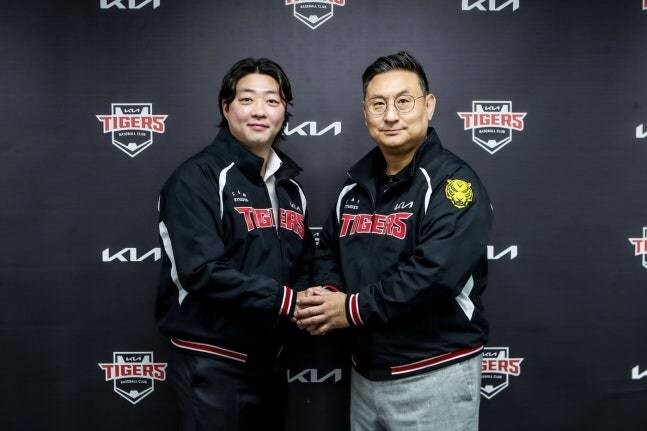
The 2026 KBO League free agency market has witnessed one of the most compelling storylines in recent Korean baseball history: the departure of pitcher Kim Beom-su from the Hanwha Eagles to the KIA Tigers. This transaction, announced on January 21, 2026, represents far more than a simple player swap. It demonstrates the intricate mechanics of Korea’s professional baseball compensation system, the strategic roster management decisions that teams must navigate, and the professional aspirations of elite athletes seeking new opportunities at the apex of their careers. When Kim Beom-su signed a three-year contract worth 2 billion won with the KIA Tigers, the baseball world immediately shifted focus to a crucial question that would redefine the competitive landscape of the 2026 season: Which KIA player would the Hanwha Eagles select as compensation?
For those unfamiliar with Korean professional baseball’s unique structure, the compensation system represents a protective mechanism designed to ensure that teams losing valuable players receive proportional value in return. The system operates on a tiered structure based on player classifications, with Grade B free agents occupying a middle ground that presents complex strategic choices for both the losing and gaining organizations. Understanding this framework requires knowledge of how Korean baseball differs fundamentally from other international baseball markets, particularly in its approach to player mobility and organizational equity. The compensation framework exists because professional baseball in Korea operates under specific regulations designed to maintain competitive balance while simultaneously allowing players the freedom to seek career advancement and higher compensation in the open market.
Kim Beom-su’s departure from Hanwha represents the culmination of his eleven-season tenure with the organization. During his time with the Eagles, he established himself as a reliable relief pitcher who appeared in 481 games over his career spanning from 2015 to 2025. His career statistics reflect consistent performance in a relief role: 27 wins, 47 losses, 5 saves, and notably 72 holds accumulated through his professional tenure. These statistics underscore his role as a workhorse in the bullpen, providing stability and depth that proved essential to the Eagles’ pitching staff throughout his decade-plus with the organization. However, the 2025 season marked a significant turning point in his professional development and career trajectory.
The 2025 season represented Kim Beom-su’s finest performance at the professional level, coinciding precisely with his decision to pursue free agency. During that campaign, he appeared in 73 games and pitched 48 innings with an extraordinary earned run average of 2.25, recorded 2 wins, 1 loss, 2 saves, and 6 holds. Perhaps most remarkably, he surrendered zero home runs throughout the entire season, a statistical achievement that highlighted his pinpoint control and the effectiveness of his pitching repertoire against opposing hitters. These career-best numbers undoubtedly influenced KIA’s aggressive pursuit and convinced the organization that Kim represented exactly the type of left-handed relief specialist necessary to address their bullpen weaknesses from the 2025 competitive campaign.
KIA’s interest in Kim Beom-su stemmed directly from a glaring organizational vulnerability: their relief pitching corps ranked ninth among the KBO League’s ten teams in 2025 with an earned run average of 5.22. This statistical reality forced the Tigers’ front office to acknowledge that championship aspirations in 2026 would require significant bullpen reconstruction and strategic player acquisitions. The acquisition of Kim Beom-su represented merely one component of a comprehensive bullpen overhaul strategy that included the re-signing of internal free agent Cho Sang-woo to a two-year, 1.5 billion won extension, the acquisition of Hong Kyun-hee from the Doosan Bears on a one-year deal worth 700 million won, and the selection of Yi Tae-yang in the second-round draft to provide additional depth.
The contract Kim signed with KIA established specific financial parameters that would trigger compensation obligations to the Hanwha Eagles. His annual salary of 1.43 billion won in 2025 became the baseline calculation for all compensation scenarios and potential payouts. Under Grade B free agent regulations, Hanwha possessed two distinct options available under KBO regulations: first, they could select one compensation player from KIA’s roster outside the protected 25-man roster while simultaneously receiving monetary compensation equal to 100 percent of Kim’s prior salary; alternatively, they could waive the player compensation requirement entirely and accept monetary compensation equal to 200 percent of his previous annual salary. This binary choice framework represented the crucial decision point that would dominate KBO League discussions in the weeks following the initial transaction announcement.
The mechanics of this compensation process involve specific procedural requirements that both teams must carefully observe throughout the designated timeframe. Upon the official announcement of Kim’s free agency contract registration, KIA possessed a three-day window to submit its protected 25-man roster to Hanwha for organizational communication. This roster would identify which players the Tigers deemed essential to their organization and therefore protected from any potential compensation claims. The selection of protected players requires careful strategic consideration, as certain categories of athletes receive automatic protection regardless of organizational preference: players who recently agreed to free agency contracts themselves, military service reserve players, athletes acquired through previous compensation transactions, and rookie-eligible players all remain protected by established regulation.
This protected roster submission represents the critical juncture where KIA must make difficult decisions about which secondary-level players might become available to Hanwha’s potential selection. Players not included on the 25-man protected roster become eligible for compensation selection and potential organizational transfer. The Eagles’ organization, understanding its specific roster needs and competitive positioning for 2026, would then possess a three-day window to evaluate the unprotected players and select one player to join their organization at no additional cost beyond the existing salary structure already in place. Alternatively, Hanwha could reject compensation player selection entirely and instead accept the doubled monetary compensation of 2.86 billion won as financial recompense.
Industry analysis and expert commentary suggested that Hanwha would likely select the player compensation option rather than accept monetary compensation alone. The Eagles’ most significant organizational gap centered on middle-field resources, particularly the center field position and overall outfield depth. Several KIA players emerged as potential compensation targets based on their position and competitive value: Park Jeong-woo, a center fielder competing for regular playing time with the Tigers; Jung Hyun-chang, an infielder with considerable upside and development potential; and Park Min, an infielder known for his exceptional defensive prowess and baseball skills. The compensation selection represented an opportunity for Hanwha to address immediate roster needs while simultaneously maintaining competitive stability throughout the season.
The broader implications of this transaction extended beyond the immediate compensation mechanics to encompass larger questions about roster construction philosophy and competitive strategy in 2026. KIA’s investment in bullpen reinforcement signaled a strategic commitment to a particular style of pitching-focused baseball that emphasized early-inning dominance by starting pitchers, followed by reliable relief coverage in middle and late innings for game management. Kim Beom-su himself acknowledged the team’s strategic vision when he stated that if starting pitchers could successfully complete five innings, the reinforced KIA bullpen, featuring him alongside Cho Sang-woo and Hong Kyun-hee, could handle innings six through nine and secure victories consistently. This conceptual framework suggested that KIA believed their pathway to 2026 success required dominant relief pitching rather than offensive explosion alone.
From a personal perspective, Kim Beom-su expressed complex emotions regarding his departure from Hanwha after eleven seasons with the only professional organization he had known throughout his career. He acknowledged the difficulty of the free agency process, describing it emotionally as a situation where “his heart was bleeding” with uncertainty and doubt. He apologized for controversial remarks made during free agency negotiations regarding the K-9 self-propelled gun, characterizing these comments as thoughtless remarks that caused him genuine distress. Simultaneously, he expressed gratitude toward Hanwha fans who had supported him throughout his tenure, while embracing the opportunity to join KIA, which he described as a prestigious organization representing a new chapter in his professional development. His stated commitment to repay the Tigers’ confidence with performance exceeding expectations represented typical platitudes voiced by newly acquired athletes, yet his specific comments about the bullpen structure and his optimism about contributing to organizational success suggested genuine enthusiasm for the new team’s direction and vision.
The timeline for finalizing all aspects of this compensation transaction proceeded rapidly through late January 2026. The official contract announcement occurred on January 21, with KBO official registration occurring on January 23 following verification procedures. KIA faced a January 26 deadline for submitting the protected 25-man roster, with Hanwha then possessing three days to announce its compensation player selection or monetary compensation election. This compressed schedule reflected the KBO League’s determination to finalize significant transactions before spring training commenced in early March. The resolution of the compensation question would represent the final piece in constructing KIA’s bullpen puzzle for 2026, while simultaneously addressing Hanwha’s strategic needs for roster reconstruction after losing their premium free agent pitcher to a division rival.
This transaction ultimately exemplifies the sophisticated mechanics underlying professional baseball in Korea and the complexity inherent in maintaining competitive balance while simultaneously permitting players to pursue career advancement and financial improvement. The outcome would influence team competitive positioning throughout the 2026 season and beyond, shaping the trajectory of both organizations.